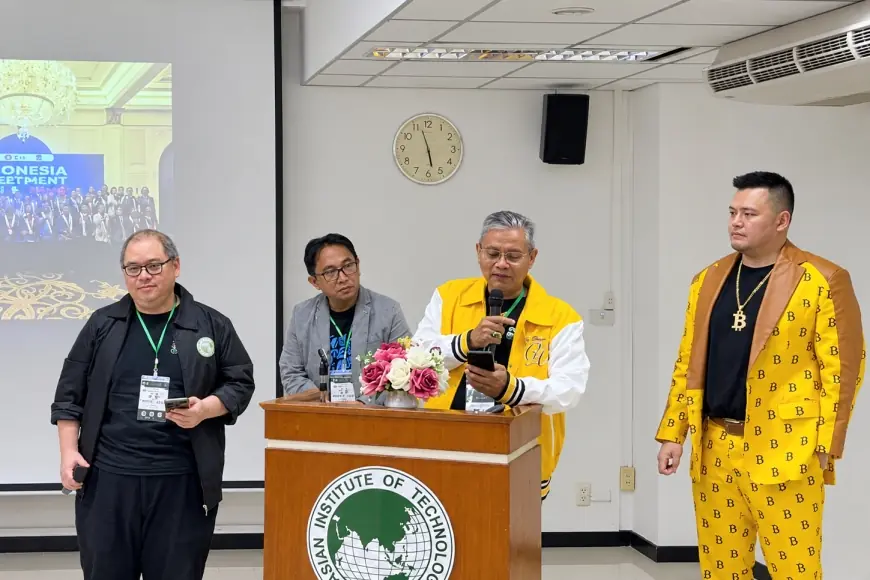
BANGKOK, SJP — In an effort to transform the education and technology landscape in Southeast Asia (SEA), PT Indonesia Kecerdasan Artifisial Network (i-KAN) has officially launched the “House of AI” initiative during the 55th Asian Institute of Technology Alumni Association (AITAA) Global Board Meeting (GBM) at the AIT campus in Bangkok, Thailand.
This initiative is designed as an innovation engine to help Southeast Asia break free from the “middle-income trap” and transition toward a Knowledge-Based Economy (KBE).
Assoc. Prof. Dr. Arman Hakim Nasution, M.Eng. Co-Founder of PT i-KAN, Chairman of the Center of Studies in Industrial Development and Public Policy (CSID-PP) at ITS, and Co-Partner of the Indonesia Blockchain Center (IBC) noted that the shift in global economic value necessitates rapid adaptation by developing nations.
“Since the 2000s, there has been a major evolution in corporate assets, shifting from physical (tangible) assets to intangible assets such as data, algorithms, and innovation patents. For context, historical data from the S&P 500 stock market in the early 2000s (around 2001) shows that intangible assets began to surge, eventually dominating 70% to 80% of total corporate value,” said Dr. Arman.

“Therefore, the future of Southeast Asia including Indonesia requires an innovation lever to transition from a Resource-Based Economy (RBE) to a Knowledge-Based Economy (KBE) in order to achieve a ‘quantum leap’ in growth,” he added.
Transforming a Market of 600 Million People into Technology Creators
When discussing regional potential, the current global landscape of Artificial Intelligence (AI) power is highly concentrated. China leads with a share of approximately 60%, driven by hardware implementation and production, as well as a high volume of AI patents. Meanwhile, the United States holds a share of about 20%, with a focus on deep-tech research and foundational AI models.
Southeast Asia, with a population exceeding 600 million, represents an untapped market potential of 20%. Through “House of AI,” i-KAN proposes two major “leapfrogs” to ensure that Southeast Asia evolves from merely being a digital market or consumer into a creator of technology and a hub for Intellectual Property (IP).
The First Leap: A Borderless Learning Ecosystem
i-KAN introduces the “Corporate Learning NDU” concept a 24/7 educational ecosystem where learning is empowered by technology. Through modules based on AI avatars, learners and professionals can access tutorials and assessments independently and flexibly. This intelligent mentoring system is designed to accelerate both “upgrading” (enhancing competency levels) and “upskilling” (acquiring new expertise).

The Second Leap: The “House of AI” Patent Exchange
A primary challenge for research in Indonesia today is commercialization. Data indicates that 60% of local patents in Indonesia originate from higher education institutions, yet fewer than 5% are successfully commercialized or adopted by the industry. In many cases, these patents serve little purpose beyond fulfilling academic administrative requirements.
House of AI serves as a proactive “Patent Exchange,” offering a clear solution: “Prototype the best ideas, and sell them!” This platform bridges the gap by connecting prototype ideas developed within academic institutions directly to the needs of the industrial market.
$18 Million in Funding and 50 AICEX Labs
To realize this vision, House of AI is supported by an initial funding commitment of $18 million over the first two years, with a target ecosystem valuation of $40 million by the third year (2028–2030).
These funds will be allocated toward establishing 50 AI Centers of Excellence (AICEX) at selected public and private universities across Indonesia and Southeast Asia. i-KAN will provide grants of up to IDR 1 billion for Tier 1 universities and up to IDR 500 million for Tier 3 universities, contingent upon the institutions providing the facilities and covering operational utility costs.

These funds will be allocated toward establishing 50 AI Centers of Excellence (AICEX) at selected public and private universities across Indonesia and Southeast Asia. i-KAN will provide grants of up to IDR 1 billion for Tier 1 universities and up to IDR 500 million for Tier 3 universities, contingent upon the institutions providing the facilities and covering operational utility costs.
Each AICEX will serve a dual function:
- Intellectual Property (IP) Commercialization Hub: Facilitating technology transfer to generate new, commercially viable patents.
- Virtual Educational Tourism: Functioning as a virtual AI museum and research laboratory accessible to everyone from elementary school pupils to university students thereby transcending the boundaries of traditional academic institutions and transforming them into accessible, real-world incubators.
Strategic KAN Collaboration in Southeast Asia
As the initiator, Indonesia (via PT i-KAN) has officially partnered with neighboring countries by launching four pioneering Artificial Intelligence Network (KAN) hubs.
A simultaneous launch took place today at AIT Bangkok, involving Indonesia, Thailand, Singapore, Malaysia, and Sarawak. Each country (or “node”) will pursue its own strategic focus; for instance, the Singapore node (Singapor-KAN) will concentrate on the integration of AI and blockchain for the halal economy. This entire AICEX network will be directly integrated with a blockchain system developed by the Indonesia/Dubai Blockchain Center.

At the conclusion of the launch, i-KAN bolstered by the full support of the Indonesian Embassy in Bangkok invited global stakeholders to join in expanding the “House of AI” network across Asia and into Africa.
“It is here, at the 55th Global Alumni Gathering (GBM) on the AIT campus, that this journey begins: building AI competencies starting from Indonesia, extending to Southeast Asia, and reaching the global stage,” concluded Dr. Arman. (***)